
Digital FOMO — When is the Right Time to Log Off from the Information Flow?
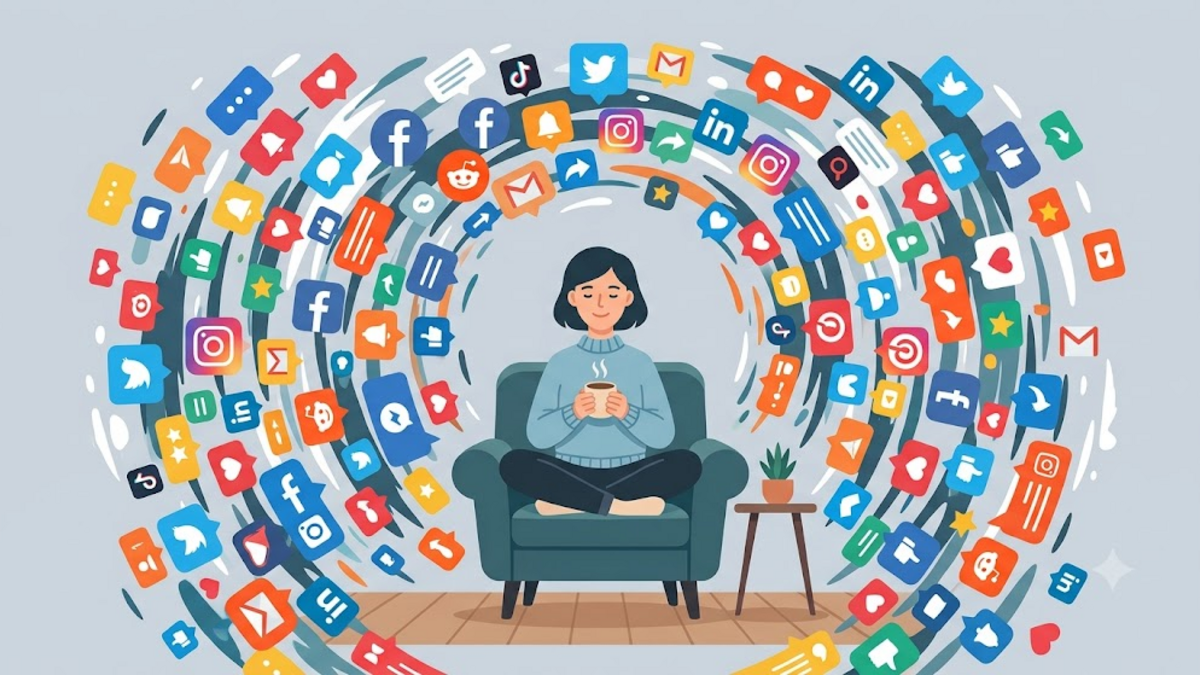
A few nights ago, I found myself caught in an all-too-familiar ritual: opening my phone to just check the time, then suddenly realizing that 40 minutes had passed, with my hands continuing to scroll through timeline after timeline. One notification led to ten posts, ten posts led to three video reels, and before I knew it, the night was deepening while my energy was running low. It's not that I'm not tired — I am, but there's a little voice whispering: "If you sleep now, you'll miss something."
That little voice is what we know as FOMO — Fear Of Missing Out. In the digital era, FOMO is no longer just worrying about missing a friend's party. It has transformed into a collective anxiety about missing out on news, trends, discussions, opportunities, even other people's lives that seem more interesting than our own. And the most dangerous: FOMO makes us spend time not on living, but on ensuring that we don't miss living.
Log Off Is Not Stupidity, But Courage
There is a popular myth that says that people who are always online are the most updated, most relevant, most informed. But my experience teaches me the opposite: people who are constantly absorbing information often have the most difficulty distinguishing what is important and what is just noise. Imagine you are standing in the middle of the busiest traditional market in the city. Everyone is screaming offering goods, news and entertainment. If you try to listen to everything at once, what you get is not understanding, but noise.
Today's internet is like that market, only the difference is that it is open 24 hours and is in our pocket. Each refresh is an invitation to log back in. Every notification is a salesperson pulling our arm. In conditions like this, deciding to log off is not a sign of being left behind, but rather a sign of independence of mind.
Never Tired Algorithms Make Us Tired
One of the things we often forget: digital platforms are designed to make us stay. Not to make us happy, not to make us wise — but to make us engaged. The infinite scroll button, the pulsing red notifications, the short content that changes every second, are all the result of very sophisticated psychological engineering.
Like a slot machine in a casino, each roll awards a random prize: a funny video, surprising news, a moving comment, or a photo of someone's vacation. Our brains are released dopamine in small doses, and we keep pulling the lever on the screen to get the next dose. What makes it dangerous: there is no natural point to stop. In books, there are chapter endings. In movies, there are credits. But on the timeline? There isn't any. Just more, more, and more.
When Other People's Lives Become a Benchmark Without Permission
FOMO often arises not because we really want to do what everyone else is doing, but because we feel we should do it. Seeing friends traveling to Japan makes us feel like our lives are monotonous. Seeing coworkers posting new certifications makes us feel like we're not growing. Seeing someone buy a new house makes us feel left behind, even though we have no intention of buying a house at all.
It's like running on a treadmill where the speed keeps increasing. You're trying your hardest, but you're not actually moving anywhere except toward exhaustion. And the irony is that the majority of what we see on social media is the best possible curation of someone's life, not the full reality. We compare our behind the scene to someone else's highlight reel, then wonder why we feel defeated.
Signs of FOMO Starting to Control Your Day
Not all anxiety is FOMO, but there are some signs that I think are pretty clear. First, you open social media apps without any conscious reason, even minutes after closing them. Second, you feel anxious or even guilty if you don't follow the latest news or trends. Third, you have difficulty focusing on one task because your mind keeps jumping to what might be happening elsewhere.
Fourth — and this is the most personal to me — you start to feel that free time is wasted time. In fact, boredom is the fuel for creativity. Many of my best ideas come to me when I'm not doing anything: while washing dishes, while waiting for coffee, or while walking without earphones. When every gap in time is filled with content, we kill the space where those ideas could grow.
Log Off Practices That Can Be Started Today
I'm not the type of person who would suggest you delete all your social media accounts and live in the mountains. For most of us — including me — the internet is a work tool, a learning tool, and a social bridge. What we need is not total disconnection, but deliberate restriction.
The simplest step is to turn off unimportant notifications. I personally turn off badges and sounds for almost all apps. Only phone calls, messages from family, and a few server alerts are allowed to interrupt. The result? My cellphone screen no longer pulses like the heartbeat of someone who is anxious.
The next step is to create a transition ritual between online and offline mode. For example, I try not to touch my phone for the first hour after waking up and the last hour before going to bed. Morning is a time to determine your own priorities, not to leave your thoughts to an algorithm. Night is the time to calm the nervous system, not to drown it in stimuli.
For work, I use a technique similar to time blocking. There are certain hours that are specifically for deep work, and that's when the cell phone is placed out of reach. Focus is a scarce resource, and FOMO is the thief.
Accepting That We Will Miss Something
This is perhaps the hardest part, but also the most liberating: we just can't keep up with everything, and that's okay. The world is too big, there is too much information, and our lives are too short to devote ourselves to every passing trend, news item, and discussion.
There is a concept that I have myself: JOMO — Joy Of Missing Out. Happiness comes from deliberately missing out on things in order to be fully present to the things that really matter. When I decided not to participate in heated debates on social media, I regained the energy to write. When I miss the latest entertainment trends, I have time to read a long overdue book. When I don't compare my life to others, I can appreciate what I already have.
Conclusion: The Internet Should Be a Tool, Not an Owner
Digital FOMO is a real problem, but it's not an inevitable curse. It is the result of a system deliberately designed to keep us trapped, coupled with the human tendency to fear missing out. The good news: we have the power to decide when to use technology and when to put it down.
Great internet. It opens up access to knowledge, connections and opportunities that were once impossible. But it can also become a black hole of time and attention if we don't give it boundaries. So, the question isn't "Should I go online?" but rather "What am I going online for, and what am I giving up?"
If you too have ever felt exhausted from constantly chasing a constant stream of information, it might be a good time to take a breath, put down your phone, and remember that life's most valuable moments often happen off the screen. Logging off doesn't mean disappearing — logging off means choosing to be present.