
Digital Privacy from an Indonesian Perspective — Why We Need to Care
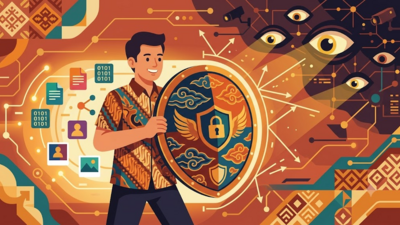
Try asking your friends: "Who reads the Terms & Conditions before clicking Accept?" Most likely, no one raised their hand. We are all used to clicking "Accept" without reading, installing applications without checking permissions, and registering for new services without thinking twice about the personal data we are handing over. Not because we're stupid — but because the digital world has been designed so that we don't have to think about privacy.
In the Indonesian context, conversations about digital privacy have a slightly different color than in Europe or America. Here, the warmth of community and the habit of sharing on social media are part of the culture. But the question is: where is the line between sharing and losing control of our personal data?
What Actually is Digital Privacy?
Digital privacy is not about hiding something "naughty." Privacy is about control. Control over who can access our information, for what purposes, and for how long. It's a bit like a house — we don't close all the windows because we have something to hide. We close windows because we want to choose when and to whom we open them.
When we use an application, we indirectly provide some of our personal data to the company behind the application. Name, location, search history, shopping habits, even sleep patterns — all of this is data that can be collected, analyzed and monetized. The question is: are we really aware of how much data we have submitted?
Indonesian Context: Regulations and Reality
Indonesia has just passed the Personal Data Protection Law (UU PDP) in 2022. This is a big step forward — our country finally has a legal framework that specifically regulates personal data. But let's be honest: implementation and enforcement are still in the early stages. Many companies, especially those operating in the digital realm, still have somewhat "lax" data collection practices
In Europe, there is the GDPR (General Data Protection Regulation) which has been running since 2018 and is known to be very strict. Companies could be fined millions of euros if they violate them. In Indonesia, the PDP Law still needs time to prove its effectiveness. But at least, we now have a legal basis to defend our privacy rights.
What's interesting is that our own habits are often more dangerous than the lack of regulation. We can easily install apps that request access to contacts, location, camera, and microphone — all at one time. We give it permission just because we want to use one small feature. In fact, once permission is given, we never know what our data will be used for.
Threats that we often underestimate
Many people think that privacy threats only come from hackers or authoritarian governments. But in reality, the biggest threat often comes from our own habits.
Have you ever felt "haunted" by advertising? Just when you talked about a product verbally — without typing anything into Google — suddenly an advertisement for that product appeared on your social media timeline. This phenomenon is not accidental. Big tech companies like Google, Meta, and TikTok have very sophisticated systems for tracking our digital habits, without us even realizing it.
Then there is the matter of the cloud services that we use every day: Google Drive, iCloud, Dropbox, OneDrive. They offer incredible convenience — access from anywhere, automatic backup, easy sharing. But have you ever stopped for a moment and asked: which server is my data stored on? Who can access it? Do they read my files?
The honest answer: we don't know for sure. And that's the crux of the problem. When we use a free service, we are not the product — we are the resource. Our data is the fuel that drives their advertising engines.
Self-Hosting: Taking Control Back
One of the most concrete ways to maintain digital privacy is by self-hosting. The concept is simple: instead of storing data on servers belonging to other companies, we store it on our own servers.
Maybe you've read about b.lan or o.lan — two projects I built on a personal home server. That is a small example of how we can have digital services that are completely under our control. No data is sent to third party servers. There are no ads. There are no terms & conditions that change at any time.
Self-hosting is not a solution for everyone. It takes effort to setup and maintain. But there's a certain satisfaction when you know that all your data — documents, photos, emails, even your own AI assistant — runs on the hardware you hold, in the room you occupy. That is a true form of digital independence.
And it doesn't have to be big. We can start small: Nextcloud for file sharing instead of Google Drive, Bitwarden for a password manager instead of saving passwords in the browser, or even Jitsi for video calls instead of Zoom or Google Meet. It's all open source, self-hosted, and free.
Open Source Philosophy and Privacy
Behind the open source movement is a basic principle that is very relevant to the topic of privacy: transparency. When a software is open source, the source code can be checked by anyone. We can see for ourselves whether the software sends our data to another server, or whether it works as promised.
Compare this with proprietary software — we can only trust what the company that makes it claims. We can't verify it. It's a bit like a restaurant with the door tightly closed: you never know what's going on in the kitchen.
In the current context of AI, this transparency becomes increasingly crucial. Many AI services offer incredible convenience — from writing articles to generating images. But beyond that convenience, our conversation data with AI can be used to train their models further. With open source LLM that can be run locally, we can enjoy the capabilities of AI without having to hand over our data to anyone.
Privacy as a Right, Not a Privilege
I believe that digital privacy is not a luxury that only certain people can enjoy. Privacy is a fundamental right — just like the right to a safe home or the right to private letters that cannot be opened by others.
But to be able to enjoy this right, we need to be aware of its importance. Be aware that every time we click "Accept" without reading, we give up some control. Be aware that every permission we give to an application is a compromise. And realize that privacy is not about hiding something bad — but about maintaining our dignity as human beings who have the right not to always be watched.
In an era where our every move is recorded, our every search is logged, and our every conversation can be analyzed — choosing to maintain privacy is an elegant form of resistance. We don't have to be activists or cybersecurity experts to get started. Just start with small steps: check your app permissions today, and ask yourself — do I really need to give all these permissions?
Maybe the answer will surprise you.