
Digital Stoism — Finding Calm Among Notifications, Expectations, and Uncertainty
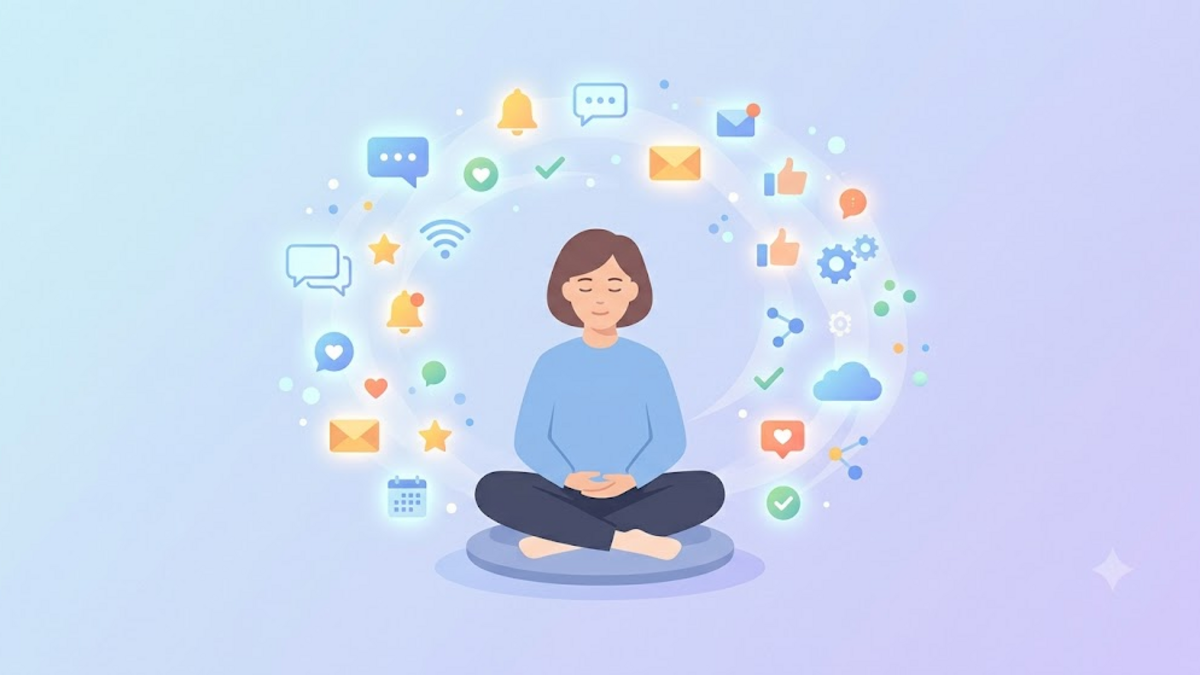
Some time ago, I found myself staring at my phone screen in the middle of the night. The screen lit up with another notification, then another, then another. It feels like standing on the side of the highway while waiting for a public transportation that never comes: noisy, uncertain, and makes your chest tight. I realized it wasn't the device that was at fault. I let my mind be occupied by every little thing that passes in front of it.
From there I started reading the Stoic philosophers again. They lived thousands of years ago, long before there were push notifications, but it was exactly the same thing: how humans maintain inner calm when the outside world is constantly noisy. This article is a small note from me after trying to translate stoicism into the language of our current digital life.
What is a Stoic, Actually?
Stoics are often misunderstood as being very stupid. In fact, stoicism does not mean not feeling. Nor is it a prohibition against hope. The point is simpler: distinguish clearly between things that are under our control and things that are not.
Philosophers such as Epictetus, Seneca, and Marcus Aurelius taught that thoughts, choices, and attitudes are ours. Meanwhile the weather, other people's opinions, traffic, fuel prices, and the number of likes on our posts are not. Just as we can't stop the rain from falling, we also can't force the digital world to always be friendly.
This concept is known as dichotomy of control: separating two areas. The inner region is us, our attitudes, our decisions. The outer region is everything that can come and go without our permission. The problem is, nowadays external areas often enter our trouser pockets every minute.
When Outer Territory Becomes Inner Territory
In the past, if someone disagreed with us, he might write letters and letters until several days later. Now, negative comments can appear shortly after we upload something. Bad news from the ends of the world comes in red notifications. A work email came in while we were having lunch. Servers can go down at any time. Everything demands a quick response.
This condition makes the boundary between the inner and outer regions thin. We easily believe that our well-being depends on things we can't actually control: the number of viewers, netizen comments, website traffic, ranking on Google, or whether the client replied to our message tonight. In fact, the more often we surrender peace to things outside of us, the more often we lose control.
Marcus Aurelius once wrote that disturbance comes not from the event itself, but from our assessment of the event. The notification is just a small vibration on the screen. What makes it a storm is our interpretation: "I have to reply now," "Otherwise people will get angry," "This must be important." The Stoics invite us to see vibrations for what they are, then choose a calmer attitude.
Dichotomy of Control for Developers and Digital Workers
I work in front of a screen almost every day. Write code, set up servers, publish articles, fix bugs. In a job like this, uncertainty is daily bread. A feature I've tested many times could be problematic in production. A commit that I think is perfect can be rejected in code review. An article that I prepared seriously can get a few visits.
The Stoics teach that my task is to prepare the best from the inner region. Write code thoroughly, document clearly, communicate politely. As a result, how many people read, or whether the system went down due to unforeseen circumstances, is outside the realm. Doesn't mean I don't care. I'm still trying to improve. But I don't attach all my worth to results that I don't fully control.
There is an old saying among the Stoics: amor fati, to love fate. This doesn't mean giving up, but accepting that every incident is raw material for acting better. Deploy failed? That is data. Criticism from users? That is input. Server down? It's a reminder to strengthen backup and monitoring. When we stop fighting reality and start working with it, our steps become lighter.
Negative Visualization: Preparing the Heart Without Inviting Bad Luck
One of the Stoic exercises that I like the most is negative visualization, or lightly imagining the bad things that could happen. Before going to bed, I sometimes ask: what if the server has a problem tomorrow? What if the article I write is not well received? What if my phone is lost? The goal is not to scare yourself, but to enrich your sense of gratitude.
In the digital era, this exercise has become even more relevant. We are used to thinking of the internet, cloud, data and contacts as permanent. However, everything can change. Accounts can be suspended, data can be lost, platforms can be closed. By imagining bad possibilities, we actually appreciate what we have now more. I've become more diligent about backing up, more selective about storing data, and less surprised when something doesn't go according to plan.
This exercise also helps me reduce FOMO, the fear of missing out on information. If I miss one trend or piece of news, the world won't collapse. If I don't reply to a chat within an hour, the friendship isn't immediately destroyed. Life goes on. The Stoics taught that calm does not come from knowing everything, but rather from accepting that we do not need to know everything.
Small Practices You Can Start Today
Stoicism is not a philosophy that asks us to be perfect. It is more like a small exercise that is repeated every day. Here are some practices I try to implement:
- Turn off non-essential notifications. I only leave on notifications from family, calendar, and health apps. I check the rest consciously, not reactively.
- Pause before responding. When I receive an emotional message, I try to wait a few minutes before writing a reply. The pause makes the choice of words clearer.
- Write a short journal entry. In the evening, I jot down one thing I can control and one thing I can't control that day. This simple exercise makes a big difference.
- Focus on the process, not the score. When writing articles or code, I ask myself: have I given my best? If so, the result is somehow an addition, not a definition of my worth.
None of these practices is revolutionary. They simply remind us that we have power over our attention. And attention is the most valuable resource in an age of distraction.
Afterword: A Little Peace in the Corner of the Room
Digital stoism is not about being an emotionless robot. It's about becoming a more conscious human being: realizing that notifications can wait, that other people's opinions are not punishment, that failure is data, and that inner peace is not sold in app stores.
I'm still often tempted to check my phone in the middle of the night. I still get disappointed sometimes when something doesn't work out. But at least now I have a little compass: ask myself, what can I control now? The answer is almost always simple: my attitude, my choices, and the way I stare at the screen that lights up in front of me.
If you also feel that the digital world often steals your peace, perhaps Stoa could be a friend to talk to. No need to buy thick books. Just start with one small question every time the screen lights up: is this something that is in my control, or is this something that I just need to let pass?