
Productivity: Quality vs Quantity — Why I Stopped Worshiping Being Busy
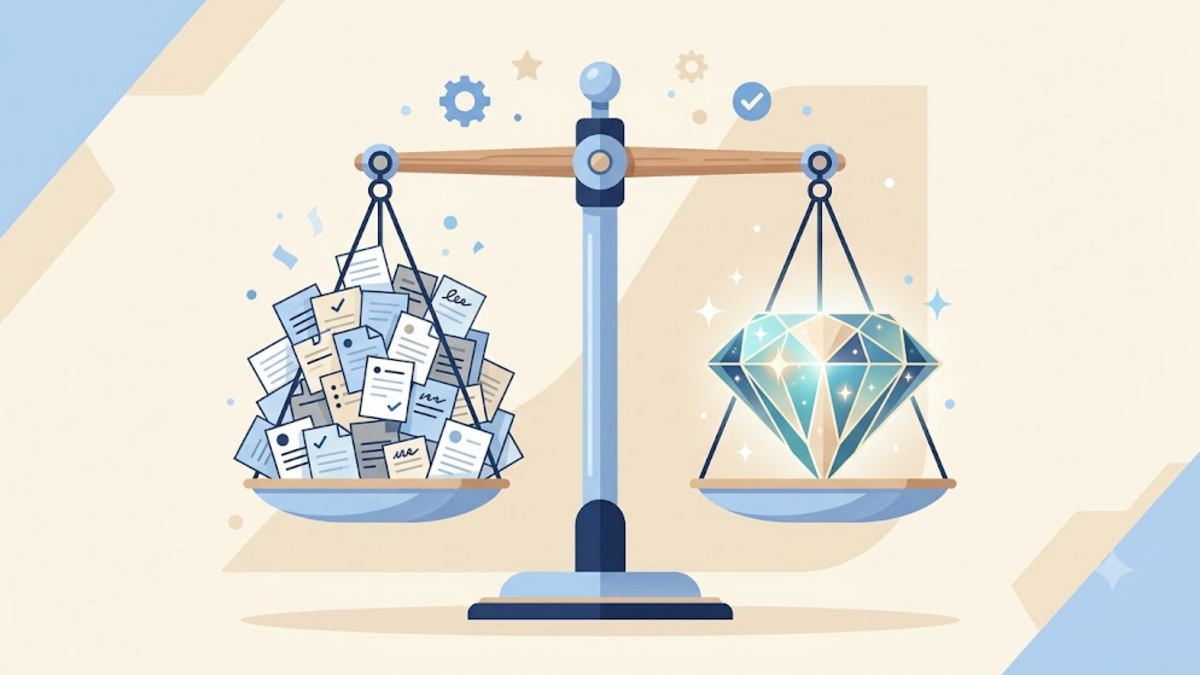
A few years ago, I had a strange habit: I liked to read articles about successful people's morning routines, and then try to copy them all. Wake up at 5, drink lemon water, meditate for 10 minutes, read a book, do light exercise, then start working. On paper, the routine looks great. But in practice, I actually spend more energy preparing myself for work than on the work itself. Productivity became like a uniform I wore to look busy, not because I actually accomplished anything meaningful.
That experience led me to a simple question that is actually difficult to answer: Am I busy because I'm productive, or do I look productive because I'm busy? The difference is subtle, but the consequences are big. And that question is what finally led me to understand the difference between quality and quantity in productivity.
The "More = Better" Logic Trap
The world of work and the world of creators often measure productivity with metrics that are easy to calculate: how many tasks were completed, how many hours worked, how much content was published, how many emails were answered. These metrics are not wrong, but they often hide one important thing: not all tasks are worth the same. Replying to 50 emails can feel like an accomplishment, but if those emails don't change anything, we've just spent energy moving information, not creating value.
I've fallen into this trap before. There was a time when I felt proud of publishing many short articles, taking many online courses, and having many project tabs open simultaneously. But at the end of the week, when I check what was actually done and had an impact, the answer is always disappointing. Many starts, few end well. Quantity-based productivity is like fast food: filling for a moment, but not providing enough nutrition for a long journey.
Padang Restaurant vs. Coffee Shop: An Analogy
Imagine two places to eat. The first is a Padang restaurant with 30 side dishes in the window. They served a lot of choices, but each side dish had been refrigerated for hours and reheated. The second is a small coffee shop that only sells three types of coffee. They roast their own beans, grind to order, and the baristas know you by name. From a quantity perspective, the Padang restaurant clearly wins. But from the perspective of experience and satisfaction, the coffee shop is much more meaningful.
Similar productivity. We can be a Padang restaurant that serves 30 half-baked things, or a coffee shop that only serves a few things, but each one is made with the utmost care. The choice isn't always easy, because the world loves big metrics. But for jobs that require thought, creativity, or technical expertise, quality almost always trumps quantity in the long run.
When Does Quantity Matter?
This is not an article attacking quantity. There are phases in life and work where quantity is actually your best friend. When we are just learning something, for example learning to code or write, we do need to produce many imperfect results. Quantity leads to quality — this is not a cliche, but a proven phenomenon. First-time writers have to write a lot of bad stuff before finding their voice. Programmers have to make many small projects fail before understanding architecture. In this phase, it is better to complete 10 simple projects than to tidy up 1 project that never gets finished.
Quantity is also important when we are building habits. If you want to start exercising, it's better to run for 10 minutes every day rather than waiting for an hour to get in the mood to run. If you want to start writing, it's better to write 200 words every day than wait for inspiration to write 2000 words. Here, quantity is not the goal, but rather the path to achieving confidence and consistency.
When Should Quality Win?
After going through the learning phase, the questions change. It's no longer "how much can I do?", but "how much do I really need to do?". This is the transition from beginner mindset to craftsman mindset. A wood craftsman does not chase the number of chairs made. He was after one chair that was comfortable, beautiful, and durable. He may only make one chair a week, but it will be remembered, recommended, and purchased at a price commensurate with his efforts.
In my own work, I started to feel this difference when I switched from “writing lots of short articles” to “writing one article that really helps the reader.” Well-thought-out articles, that solve real problems, that come with examples and code to try, have much better longevity. Articles like this continue to get traffic even after they have been published for months. Meanwhile articles written in a hurry, even though there are many of them, are often simply lost in the sea of content.
Deep Work and Space to Do Nothing
Cal Newport in his book Deep Work states that valuable work in the digital era is work that requires deep focus without distraction. It's not about how many hours we are in front of a screen, but how many hours we are actually thinking sharply. Deep work is a state where we are forgotten by time, not because we are tired, but because we are completely immersed. People also call it flow state.
What's interesting, deep work cannot happen if we don't leave free space. The brain does not work like a continuously moving conveyor belt. The brain works more like a farm: it needs time to rest in order to produce a good harvest. That's why I've started to appreciate "doing nothing" time: going for a walk without a podcast, sitting on the porch without my phone, or just staring at the sky for a moment. Those empty spaces are not a waste of time. They are the fuel for quality focused moments.
Three Small Practices That Changed the Way I Work
Here are three practices that I now try to implement every day. They're not perfect, and I still fail a lot, but when I do manage to implement them, the results feel much more satisfying.
First, determine the "one important thing" before opening the phone. I write down one task that I really want to complete that day. Not five, not ten, but one. This helps me avoid the "long but meaningless to-do list" trap. If the task is completed, the day can be considered a success, even if other things have not been touched.
Second, use a timer to enforce boundaries. I often use techniques like Pomodoro, but with modifications: 50 minutes of focus, 10 minutes of rest. This time limit makes me more realistic about what can be accomplished. Like Parkinson's Law which says that work will expand to fill the available time, I make the available time narrower so that work doesn't expand without direction.
Third, review the weekend with one question: "This week, what was one thing I did well, and what was one thing I really didn't need to do?" This question forces me to be honest. Sometimes I find that I spend time on tasks that could have been removed or delegated. Sometimes I find that the small tasks I'm proud of actually don't have any impact.
Real Productivity Is Not Racing
At the end of the day, the productivity we're after isn't about who is the busiest or who has the longest to-do list. True productivity is about alignment: between what we do, what we care about, and what we actually produce. That's why I stopped worshiping busyness. I'd rather get a few things done that matter than a lot of things that just fill my time.
If you too are feeling tired of constantly chasing quantity, maybe it's time to stop for a moment and ask: what do I really want to build? The answer may not be immediately obvious, but the question itself is worth it. Because good productivity always starts with the courage to choose, and choosing means having the courage to leave behind things that are not essential.
How about you? Are you more comfortable with a rhythm of quantity or quality? Or maybe you are trying to balance both? Write your experience in the comments column. I want to hear different points of view.