
Ancient Cynicism and Diogenes of Sinope: What the Word Actually Meant
The word usually arrives as an accusation. When someone is called a cynic in ordinary English, the charge is that everybody is only interested in themselves and that nobody is sincere. Dictionaries record exactly that sense, and it is a modern one.
But the word has an older and stranger second life. It comes from a Greek adjective, kunikos, meaning dog-like, and it was the name of a group of philosophers who argued that the real problem with human life was not human nature but human convention. They thought the respectable parts of society — reputation, birth, property, ceremony — had been mistaken for goodness itself. Their answer was not a better argument. It was a life lived so inconveniently that the convention had to become visible.
So the useful question is not “what does cynicism mean” but “which cynicism, and who decided”. That second question has an awkward answer: the honest one requires admitting how little of what the Cynics actually said survives.
Chapter references here follow the R. D. Hicks translation of Diogenes Laertius (Loeb Classical Library, 1925). One warning: the Internet Encyclopedia of Philosophy numbers the Alexander anecdote as VI.28, so a chapter reference from another account may not match.
First, an honest limit: almost nothing they wrote survived
The Internet Encyclopedia of Philosophy puts the problem plainly: the evidence for the Cynics is limited to apothegms, aphorisms and ancient hearsay, and “none of the many Cynic texts have survived”. The tradition was recorded through the lives of its practitioners rather than through their doctrines.
That has a direct consequence for anyone writing about Cynicism today, including this article. Most sentences of the form “the Cynics held that…” are really sentences of the form “a later compiler arranged sayings under this heading”. That is the difference between a position and a portrait of one.
The main source for the best-known Cynic, Diogenes of Sinope (c. 404–323 BCE according to the same encyclopedia), is Book VI of Diogenes Laertius' Lives of Eminent Philosophers. It is a rich text, and it repeatedly marks its own uncertainty — which turns out to be one of the more instructive things about Cynicism.
Even the name is disputed
Three explanations of kunikos are in circulation, and the encyclopedia describes the origin of the word as “a point of contention”. The first derives it from the Cynosarges, a gymnasium and temple used by Athenian nothoi — people without Athenian citizenship — where Antisthenes is said to have taught. The second explanation derives it from a nickname attributed to Antisthenes meaning roughly a plain dog. The third makes Diogenes himself the source: “the term may have begun as an insult referring to Diogenes' style of life, especially his proclivity to perform all of his activities in public”.
The encyclopedia notes that Antisthenes' contemporaries, Plato and Xenophon among them, did not call him a dog, which lends some weight to the idea that the label was applied after his death and after Diogenes had arrived on the scene. So the label we use for the movement may be an insult that stuck. What is striking is what happened next: the early Cynics “embraced their title: they barked at those who displeased them, spurned Athenian etiquette, and lived from nature”. A disparaging label became a self-description.
What they argued, in their own words
The core claim is that virtue consists in living in accord with nature, and that convention systematically gets in the way. Diogenes Laertius compresses the position into one line: “to fortune he could oppose courage, to convention nature, to passion reason” (VI.38).
From that, concrete consequences follow in the text. On political life: “The only true commonwealth was, he said, that which is as wide as the universe”, and good birth, fame and “all such distinctions” were to be ridiculed as “showy ornaments of vice” (VI.72). On training: “training was of two kinds, mental and bodily”, and neither half is complete without the other (VI.70). On what is actually valuable in speech: asked what was the most beautiful thing in the world, Diogenes answered “Freedom of speech” (VI.69).
That last answer is the one that most resists the modern stereotype, because it is not a cynical answer. Asked where he came from, he is reported to have said “I am a citizen of the world” (VI.63) — and the compiler immediately adds a footnote questioning whether the answer is authentic. The same passage records him saying philosophy had given him one thing at least: to be prepared for every fortune.
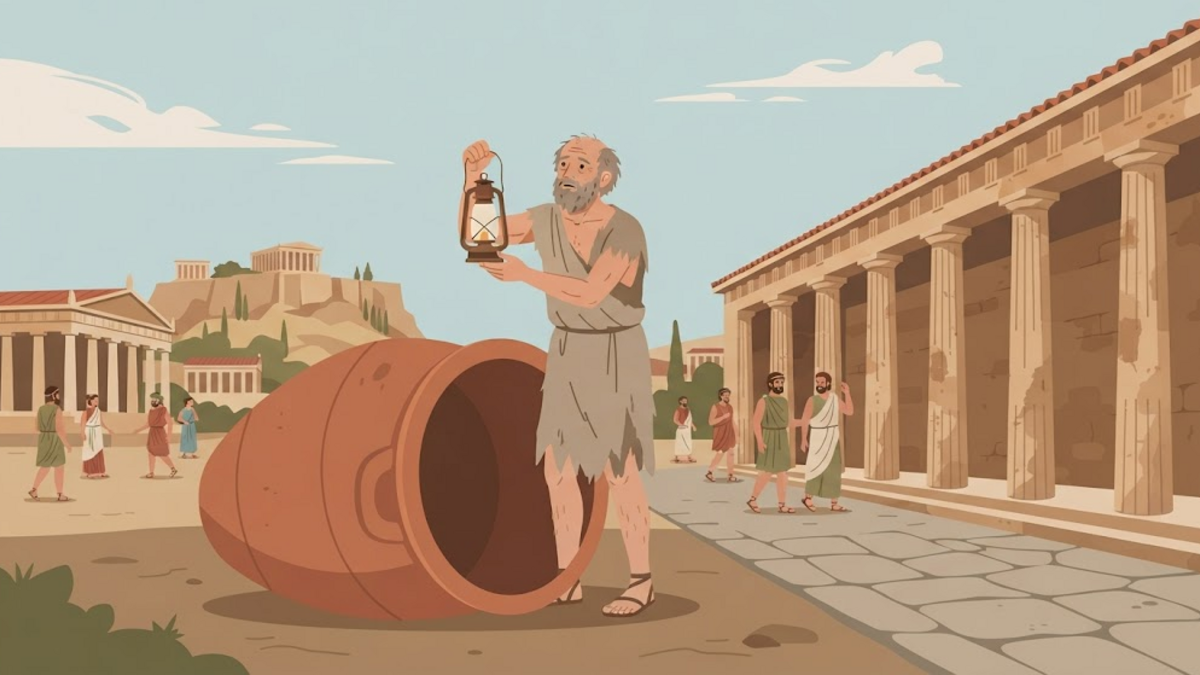
Two more sayings show the method. Confronted by Alexander the Great, who offered him anything he asked for, Diogenes is reported to have said “Stand out of my light” (VI.38). And he “lit a lamp in broad daylight and said, as he went about, ‘I am looking for a man’” (VI.41). Read carelessly, both look like quotable eccentricity. Read carefully, both are complaints: about obstruction, and about the difficulty of finding anyone actually living rationally.
The Cynics also described themselves as a shortcut. Diogenes Laertius records that “it has been said that Cynicism is a short cut to virtue; and after the same pattern did Zeno of Citium live his life” (VI.104). Zeno founded Stoicism, and the encyclopedia traces a line of transmission through Antisthenes, Diogenes, Crates and Zeno. Cynicism and Stoicism were close enough to blur, which is one reason a general reader may know the Stoics and not the Cynics.
The method was provocation, and provocation has a cost
It would be tidy to present Cynicism as a set of principles. The sources do not allow it. What they mostly preserve is behaviour: eating, sleeping, answering, refusing to be impressed, mostly in public and mostly in front of witnesses. Diogenes Laertius reports him declaring that “for the conduct of life we need right reason or a halter” (VI.24), which compresses the whole philosophy into a choice between reasoning and being led.
Some of the reported behaviour was designed to break decorum, and some of it was simply indecent. The compiler preserves one market-place anecdote in which Diogenes wished it were as easy to relieve hunger by rubbing an empty stomach (VI.46). The encyclopedia reads this shamelessness not as nihilism but as a repositioning: if an act is not shameful in private, performing it in public does not make it shameful. That is a modern scholar's interpretation, not a statement by Diogenes.
Ancient contemporaries were less generous. Asked what sort of man Diogenes was, the answer recorded is “A Socrates gone mad” (VI.54), and the compiler's note attributes the remark to Plato. Whether that is a compliment is the whole question. A Cynic was expected to be the living argument that convention could be refused; Plato's jibe implies that the argument had started to look like a performance.
Criticism from inside the tradition
The most useful corrective comes from inside Cynicism itself. Epictetus devotes Book II, chapter XXII of the Discourses — “Of the Cynic Philosophy”, in Elizabeth Carter's translation — to what a Cynic is supposed to be, and opens by warning that anyone who attempts so large a thing without God is hateful and has no other purpose than to act indecently in public.
Then comes the accusation that matters. Epictetus asks his interlocutor to consider “Cynics as they are now, who stand like dogs watching at tables, and who imitate the Cynics of old in nothing, unless perhaps in breaking wind, but absolutely in nothing besides”. This is not a modern cynic diagnosing a philosopher. It is a later Stoic telling the Cynics that their method has degenerated into a costume.
Epictetus is also strict about what the life has to demonstrate. The Cynic must show by his body that the simple diet and open air do not injure the constitution: “See, I and my body are a witness of this.” And the authority to rebuke others comes from conscience rather than from arms and guards, as with kings and tyrants: a Cynic still tangled in some vice while reproving others must be “a common cheat, and a rascal”. The bar he sets is a bar about honesty, not about austerity.
The tradition also documented its own decline. The encyclopedia states that as a “school of thought” Cynicism ends in the sixth century CE, and that two of Julian's orations from 361 CE disparage the Cynics of that day precisely for lacking the asceticism and hardiness of the “real” Cynics. The literary afterlife outlasted the philosophical one: Menippus, a Cynic whose books “overflow with laughter” (VI.99), is remembered for satire rather than doctrine — and even his attributed works were doubted by ancient authorities, who alleged they were written by others and passed off under his name (VI.100).
What the evidence cannot settle
The most instructive passage in the whole compilation is a bibliographic one. Diogenes Laertius lists the writings attributed to Diogenes — dialogues including Cephalion and Pordalus, seven tragedies including Heracles and Medea, and letters — and then immediately records that Sosicrates and Satyrus said Diogenes left nothing in writing at all, with the tragedies possibly the work of his friend Philiscus (VI.80). The compiler is listing works he does not trust.
Biography is no firmer. Why Diogenes left Sinope has at least three mutually incompatible answers within two chapters: that his father was entrusted with public money and debased the coinage; that Diogenes did it himself and fled with his father; and that an oracle told him to alter the political currency and he misunderstood the instruction (VI.20–21). The encyclopedia questions whether he consulted the oracle at all, noting that the advice sits suspiciously close to Socrates' own injunction. The circumstances of his death are equally plural (VI.76–79).
This is not a reason to avoid the sources; it is a reason to phrase claims carefully. “A later compiler attributes to Diogenes the reply ‘Stand out of my light’” is a safer sentence than “Diogenes told Alexander to move”, and it is not a less interesting one.
So what is a modern cynic, and what was a Cynic?
The Cambridge Dictionary defines a cynic as “a person who believes that people are only interested in themselves and are not sincere”. That is a claim about other people's sincerity, and it is usually a way of declining to participate.
The Cynic's claim was different in kind. It was aimed at convention rather than at people, and it was meant to be carried by a life rather than held as an opinion. A modern cynic distrusts sincerity; the Cynic distrusted the classification of things as respectable, and then made that distrust expensive to everyone nearby, including himself.
It would be easy, and wrong, to present this as one continuous tradition with a clean meaning. The two senses share a word and a mocking tone; beyond that the continuity has to be argued, and this article does not argue it.
What is left that is worth taking seriously
The following is interpretation, not a summary of the sources, and it should be read as such.
First, pointing at a status game does not by itself change the game. The Cynics' target was convention, not any particular technology, and their instrument was inconvenience: making a claim cost something visible. An observation that costs nothing tends to be absorbed rather than answered.
Second, a claim you do not live is not yet a position. The Cynics' askesis — training — was mental and bodily at the same time (VI.70), and the point of the pair was that someone who taught detachment while enjoying every privilege of attachment had proved nothing. The test was deliberately inconvenient, which is exactly why it is hard to keep.
Third, their own tradition policed itself. Epictetus's complaint is not that the Cynics were too radical; it is that they had become decorative. A movement that only criticises and never revises eventually becomes the thing it mocked, and Epictetus says so while still believing the Cynic calling is worth the trouble. That self-correction is probably the most transferable part of the history.
What should not be taken from this is the costume. A Cynic life depended on a specific social world: a gymnasium outside the walls where a stranger could live in a tub and be tolerated, and a city whose conventions were visible enough to be worth attacking. Copying the manner without the argument produces only rudeness, which is a different thing entirely and considerably easier.
Open questions
Several questions resist a confident answer, and it seems better to leave them open than to close them neatly.
Whether “ancient Cynicism” was ever a coherent school is contested, and the encyclopedia notes that calling the Cynics a “school” immediately raises a difficulty for such an unconventional and anti-theoretical group. Whether Diogenes wrote anything is genuinely unknown. Which of his several possible biographies is the real one is likewise unknown. And every account of what the Cynics meant reaches us through translations, which solve one set of problems and create another.
None of this makes the topic unfruitful. It makes it a study in how a claim survives when its author does not. The Cynics left no system and almost no text; what they left was a method — name what everyone accepts, then live as if the acceptance were optional, and see who is willing to say that it is not.
References
- Diogenes Laertius, Lives of Eminent Philosophers, Book VI — translated by R. D. Hicks, Loeb Classical Library, 1925 (public domain). Wikisource
- Diogenes Laertius, Lives of Eminent Philosophers, Volume II (Books VI–X) — scanned printing of the 1925 Loeb edition, Internet Archive
- Epictetus, Discourses, Book II, chapter XXII, “Of the Cynic Philosophy” — translated by Elizabeth Carter, edited by W. H. D. Rouse, Everyman's Library, J. M. Dent & Sons. Internet Archive
- “Cynics” — Julie Piering, Internet Encyclopedia of Philosophy
- “Diogenes of Sinope” — Julie Piering, Internet Encyclopedia of Philosophy
- “cynic” — Cambridge Advanced Learner's Dictionary & Thesaurus, Cambridge University Press