
Why a Blog Post Without a License Statement Is Not Free to Reuse
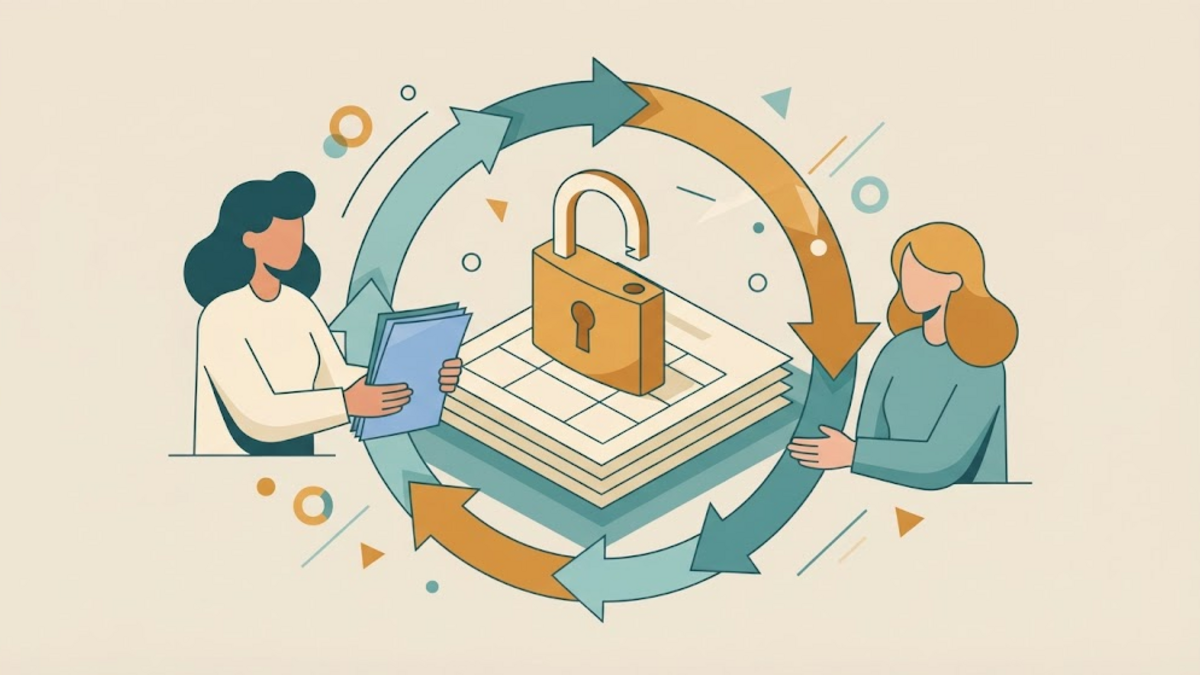
Somebody writes to a small blog and asks a simple question: may I translate your article into my language and republish it on my own site? The writer usually means well. The problem is that the blog has never answered the question, because the only copyright statement in the footer says "© 2026 Adam Muiz — All rights reserved." That sentence is not a missing answer. It is an answer, and it is the strictest one available.
I checked the live HTML of this site on 30 September 2026 while writing this, and that footer line is what appears there. It is also the theme's fallback text rather than a considered editorial decision, and there is no rel="license" link or Creative Commons statement anywhere in the site content. So the honest starting point for anyone reading these words is the default one, and this article is about what that default grants, what a license changes, and how to state a license in a way that survives contact with other people.
Three limits up front. I am not a lawyer and this is not legal advice. I am not telling you which license to pick for your site. And nothing below is a claim that I tested any of this on a real project — every version-specific statement is pinned to documents I opened while writing, listed at the end.
The default you already chose
Copyright is not something you apply for. It arrives on its own. Indonesia's Copyright Law No. 28 of 2014 defines it in one sentence: "Hak Cipta adalah hak eksklusif pencipta yang timbul secara otomatis berdasarkan prinsip deklaratif setelah suatu ciptaan diwujudkan dalam bentuk nyata…" — copyright is the creator's exclusive right, arising automatically on a declarative principle once a work is realised in a tangible form. The Berne Convention reaches the same place from the other direction: the enjoyment and exercise of the author's rights "shall not be subject to any formality." No notice, no registration, no ceremony. You wrote a post and hit publish, and you own exclusive rights over it.
Article 4 of that law splits those rights in two, and Article 9 lists what the economic half covers: publishing (penerbitan), reproduction "dalam segala bentuknya" (in any form whatsoever), translation (penerjemahan), adaptation, arrangement, or transformation, distribution, performance, announcement, communication, and rental. Article 9(2) says anyone who exercises those rights must obtain permission from the creator or rights holder, and Article 9(3) prohibits reproduction and commercial use without permission. The United States arrives at a comparable result through a different list — reproduction, preparation of derivative works, distribution, public performance, and public display — as the U.S. Copyright Office describes them, and it is explicit about authorship: "Once you create an original work and fix it, like taking a photograph, writing a poem or blog, or recording a new song, you are the author and the owner."
So the answer to the reader who asked about translating and republishing is, absent permission: no. Not out of spite, and not because translation is special. Translation is simply one of the rights you hold by default, which is also why it is one of the rights a license can hand on.
Creative Commons frames the same gap from the other side. Their FAQ describes copyright as "a bundle of exclusive rights over their creative works, which generally include, at a minimum, the right to reproduce, distribute, display, and make adaptations," and notes that "All Rights Reserved" is often used by owners "to indicate that they reserve all of the rights granted to them under the law." CC licenses, they say, "offer creators a spectrum of choices between retaining all rights and relinquishing all rights (public domain), an approach we call 'Some Rights Reserved.'" That middle is what a license is for.
What a Creative Commons license actually is
First, a CC license is not something you write. You choose from six texts Creative Commons wrote, normally the 4.0 International versions, built from four elements: BY (attribution), SA (share alike), NC (noncommercial), ND (no derivatives).
Second, every license arrives in two layers, and the difference matters. The deed is the friendly summary; the legal code is the license. The deed is unusually honest about this, stating on its face that it "highlights only some of the key features and terms of the actual license. It is not a license and has no legal value." When you are unsure what you are agreeing to, the answer is the legal code.
Third, "International" is a technical word, not a boast. Creative Commons used to produce jurisdiction-specific ported versions, adjusted to local law. Their FAQ states that "there are currently no ported versions of 4.0," that they expect there will be few if any, and that "all official translations of the 4.0 international licenses are equivalent: you may substitute one for another depending on your preferred language." The deed pages are available in many languages, including Bahasa Indonesia; I did not check whether any particular translation is current, so treat that as something to verify rather than assume.
BY and BY-SA: one difference that changes who may build on you
CC BY and CC BY-SA are the two licenses most small sites actually consider, and they differ in exactly one respect. Both let reusers copy, redistribute, remix, and build upon the material for any purpose, including commercially, as long as credit is given. Under BY-SA, Section 3(b) adds that "the Adapter's License You apply must be a Creative Commons license with the same License Elements, this version or later, or a BY-SA Compatible License." Section 2 of the legal code also carries a condition both licenses share: you may not "offer or impose any additional or different terms or conditions on, or apply any Effective Technological Measures to, the Licensed Material" if that restricts what other recipients may do with it. In practice: you cannot add terms of your own to someone else's reuse.
There is a case where that difference is not academic: translation. The BY-SA 4.0 legal code defines Adapted Material to include material in which the licensed work is "translated, altered, arranged, transformed, or otherwise modified."
Which means: under CC BY, a translator may publish their translation, attribute you, note that they modified the work, and license the translation however they like. Under CC BY-SA, they must publish it under CC BY-SA 4.0 or an approved equivalent. Under CC BY-ND, they may not publish a modified version at all — Creative Commons' attribution guidance puts it plainly for a book: "If you would like to make a translation of the book, for example, you will need to ask the author for permission first."
This site is a live example of the question, because every published article here exists in English, Indonesian, and German. A reader who wanted to bring one of these articles into a fourth language would be asking me for permission, not reading a license. That is not a complaint; it is the default working as designed.
The honest counter-argument against BY-SA is that ShareAlike is real friction. A translator who wants to put the text in a printed book, a paid course, or a newsletter under their own terms cannot. A language community that cannot maintain a CC BY-SA chain loses the work, even though the license was meant to help it circulate. If your goal is maximum reach for the words themselves, BY is the more permissive instrument. If your goal is that any derivative keeps the same permission level, BY-SA is the one that enforces that goal. I do not think one of these is correct in general; the right answer depends on what you are trying to protect, and that is your judgement, not mine.
Attribution is the condition you will actually be judged on
All six licenses include BY, so attribution is the one unavoidable condition. The BY-SA 4.0 legal code is specific. If you share the licensed material, Section 3(a)(1) requires you to retain, where the licensor supplied them: identification of the creator(s) and anyone else designated for attribution, in any reasonable manner requested and including by pseudonym if designated; a copyright notice; a notice that refers to the Public License; a notice that refers to the disclaimer of warranties; and a URI or hyperlink to the licensed material to the extent reasonably practicable. You must also indicate if you modified the material, retain an indication of previous modifications, and state that the material is licensed under this Public License with its text or a link to it.
This is not a rigid format. "You may satisfy the conditions in Section 3(a)(1) in any reasonable manner based on the medium, means, and context in which You Share the Licensed Material," and it may be enough to provide a link to a resource that contains the information. A footer line, a caption, or one credit sentence inside an article can all work. Note what is not in that minimum list: the title of the work is not a required element. Creative Commons' recommended practice is easier to remember than the legal text — TASL, for Title, Author, Source, License — and they are explicit that you should "make sure to name the specific CC license the material is under and link to it." On modification, the FAQ is equally relaxed: "It is not necessary to note trivial alterations, such as correcting a typo or changing a font size."
Three mistakes recur often enough to name. Crediting the platform instead of the person. The legal code asks for "identification of the creator(s)," and the Copyright Office is blunt that when you fix an original work you "are the author and the owner" — so a credit that names the host, or that says only "found on this site," has skipped the one element the license actually requires. Hiding the credit where readers will not meet it, in metadata or invisible markup, when the same provision asks you to retain the information and the FAQ lets you satisfy it with a link to where the information lives. And implying endorsement: Section 2 of the legal code states that nothing in it "constitutes or may be construed as permission to assert or imply that You are, or that Your use of the Licensed Material is, connected with, or sponsored, endorsed, or granted official status by" the author, and the FAQ adds that implying sponsorship or connection without permission may be unlawful.
Marking a page: a few lines of HTML that actually matter
You do not need a machine to make your licensing legible to one, but it helps. The HTML Standard has a link type for exactly this. Section 4.6.8.10 defines the license keyword: it "indicates that the referenced document provides the copyright license terms under which the main content of the current document is provided," and it may be used on link, a, area, and form elements.
<link rel="license" href="https://creativecommons.org/licenses/by-sa/4.0/">

<p>
  Except where otherwise noted, the text on this page is licensed under
  <a rel="license" href="https://creativecommons.org/licenses/by-sa/4.0/">CC BY-SA 4.0</a>.
</p>
Note the caveat in the specification itself: the HTML Standard "does not specify how to distinguish between the main content of a document and content that is not deemed to be part of that main content," and says the distinction should be made clear to the user. That is why the sentence matters as much as the attribute. rel="license" alone is an instruction to a machine with no idea whether it covers your whole site, your code samples, your images, or the third-party screenshots inside a tutorial. A plain sentence — "except where otherwise noted" — closes that gap for humans, and it is the habit Creative Commons' own marking guide recommends, summarised as ALM: Author, License, Machine-readability. The same guide is blunt about naming: "Don't just say the material is Creative Commons, because that says nothing about how the material can actually be used." For the machine-readable side, the FAQ notes that Creative Commons "has specified CC REL as a way to associate machine-readable licensing metadata with objects offered under CC licenses," and their marking guide notes that their license chooser will hand you "an already formatted HTML code" block to paste into a page — or into a template, if everything on the site shares one license.
This is not merely cosmetic in Indonesia. The Copyright Law recognises two kinds of copyright information, and Article 7(2) lists what "informasi elektronik Hak Cipta" may contain, including a work that appears attached electronically in connection with its publication, the creator's name, alias, or pseudonym, whether the creator holds the rights, and the term and conditions of use. Article 7(3) says this information, held by the creator, "dilarang dihilangkan, diubah, atau dirusak" — it may not be removed, changed, or damaged. Attaching a license link to your page is one of the most natural ways to honour that.
What a Creative Commons license does not do
It does not license your name. Section 2 of the BY-SA 4.0 legal code is unambiguous: "Patent and trademark rights are not licensed under this Public License." CC0 is explicit too: "No trademark or patent rights held by Affirmer are waived, abandoned, surrendered, licensed or otherwise affected by this document." If your site's value is partly in its name and its look, those do not travel with the license.
It does not license other people's content inside your work. A post that quotes a book, embeds a screenshot, or includes a third-party diagram under an exception contains material you do not own. The license's own preamble asks licensors to "clearly mark any material not subject to the license," and the FAQ spells out the reason: reusers "do not think the CC license applies to that material" if you do not. Your license "only applies to the rights you have in the work."
It gives no warranties. Section 5, "Disclaimer of Warranties and Limitation of Liability," says that to the extent possible the licensor "offers the Licensed Material as-is and as-available, and makes no representations or warranties of any kind concerning the Licensed Material." Nobody is promising your article is accurate, current, or free of third-party claims. That is the same limitation as any other as-is content; a CC license just makes it explicit.
It does not settle everything about automated reuse. Creative Commons is direct in its current guidance on licensing in an AI ecosystem: "CC licenses are copyright tools. They communicate permissions where copyright applies." Uses that fall outside copyright — and in many jurisdictions existing exceptions may permit certain AI uses regardless of the attached license — are not settled by changing the license, and as they put it, "A CC license doesn't override those exceptions." Their own conclusion is that "the current CC license is not always the tool that can govern those issues," which is why "where copyright licensing alone is not enough, we are working on new approaches." One of those is CC Signals, "a flexible, commons-friendly framework for communicating expectations around AI use of content and data." A license chosen for readers in 2026 should not be mistaken for an answer to a 2030 question.
The three expensive mistakes
Thinking you can take it back. The legal code states plainly that "our licenses are irrevocable," and Section 6 adds that a licensor may stop distributing the material at any time but that doing so "will not terminate this Public License." You can stop offering your own copies; you cannot recall the ones already out there. Choosing a license is a one-way door.
Ignoring what non-compliance does. Under Section 6(a), if you fail to comply, "your rights under this Public License terminate automatically." Section 6(b) is kinder: rights "reinstates: automatically as of the date the violation is cured, provided it is cured within 30 days of Your discovery of the violation; or upon express reinstatement by the Licensor." But the same section notes this "does not affect any right the Licensor may have to seek remedies for Your violations," so a cured violation still leaves the rights holder free to complain about what you did.
Changing the terms and still calling it CC. Creative Commons' marking guide is direct: "any restriction or modification to the original license cannot be labeled a 'Creative Commons' license." Add a "no AI training" clause to CC BY and you have not created a CC license; you have created a private permission with a borrowed name, and any machine-readable metadata now attached to it is wrong.
A short checklist before you choose
Not a decision procedure, just the questions I would want answered:
- Do I want credit, or do I want people able to build on this without asking? (BY versus BY-SA versus neither.)
- Do I care about commercial reuse? The CC glossaries define a commercial use as one "primarily intended for commercial advantage or monetary compensation," a harder test than it looks when a company has mixed motives.
- Do I want to keep the door closed to translations and adaptations? ND is the strictest of the six, and the strictest to reverse.
- Do I own everything in the work, or is some of it third-party material I should mark as excluded?
- Where will the statement live — every page, or a template — and is it a sentence a human reader would understand?
What I did not check, and cannot tell you
Copyright treatment is territorial, and I am not qualified to give legal advice anywhere. I have deliberately not surveyed how a Creative Commons license interacts with non-Berne law, with moral rights regimes, or with text-and-data-mining rules. The two copyright terms I mention are the ones I verified: Indonesia's Copyright Law protects a work for the creator's life plus 70 years, and the U.S. Copyright Office states that works created on or after 1 January 1978 "have a copyright term of life of the author plus seventy years after the author's death." That they happen to match does not mean the laws do.
I also did not measure whether any of this changes reader behaviour, reach, or revenue on a small site. Nobody can responsibly quote a number for that from the documents above, and I would treat any article that did as marketing.
So the narrow summary. A post with no license statement is not neutral; it is fully reserved, and in both Indonesia and the United States that default covers reproduction, adaptation, and translation. A Creative Commons license is a borrowed, well-tested text that trades some of that exclusivity for reach, on the condition that you say clearly who wrote the thing, what license applies, and whether it was changed. Once you apply one, you cannot take it back. A license describes permissions; it does not promise that the work underneath is right.
References
- Republic of Indonesia, Law No. 28 of 2014 on Copyright (UU No. 28 Tahun 2014 tentang Hak Cipta), enacted 16 October 2014, State Gazette LN.2014/No.266; record and abstract via JDIH Badan Pemeriksa Keuangan, full text via the gazette PDF. Accessed 30 September 2026.
- World Intellectual Property Organization, Berne Convention for the Protection of Literary and Artistic Works (as amended on September 28, 1979), Article 5. Accessed 30 September 2026.
- U.S. Copyright Office, What is Copyright?. Accessed 30 September 2026.
- Creative Commons, Attribution-ShareAlike 4.0 International Public License (legal code). Accessed 30 September 2026.
- Creative Commons, Attribution 4.0 International (deed). Accessed 30 September 2026.
- Creative Commons, Attribution-NoDerivatives 4.0 International (deed). Accessed 30 September 2026.
- Creative Commons, Attribution-NonCommercial-NoDerivatives 4.0 International (deed, glossary). Accessed 30 September 2026.
- Creative Commons, CC0 1.0 Universal (legal code). Accessed 30 September 2026.
- Creative Commons, The CC Licenses. Accessed 30 September 2026.
- Creative Commons, Frequently Asked Questions (sections used: what "Some Rights Reserved" means; how to attribute; ported versions and official translations; marking third-party content; CC REL; endorsement). Accessed 30 September 2026.
- Creative Commons, Guidance on licensing in an AI ecosystem. Accessed 30 September 2026.
- Creative Commons Wiki, Recommended practices for attribution (TASL; page last edited 4 December 2024). Accessed 30 September 2026.
- Creative Commons Wiki, Marking your work with a CC license (ALM, license chooser, third-party content; page last edited 25 February 2019). Accessed 30 September 2026.
- WHATWG, HTML Standard, link type "license" (section 4.6.8.10). Accessed 30 September 2026.